 Puresys纯净系统-软件下载
介绍
Darktable 是一个非常全面的照片处理程序,可让您在数字暗房中编辑 RAW 图像文件。我们的想法是能够处理您的底片,并以非破坏性的方式轻松返回原始方式。该程序与 400 多种不同的相机型号兼容,让您可以通过无穷无尽的功能完整、专业地编辑您的照片。
在处理照片时,您可以从台式计算机或直接从您使用的相机导入它们。 Darktable 的伟大之处在于它提供了一个完整且可定制的导入系统。例如,它甚至可以让您将一系列照片变成延时摄影,以及其他选项。
软件截图
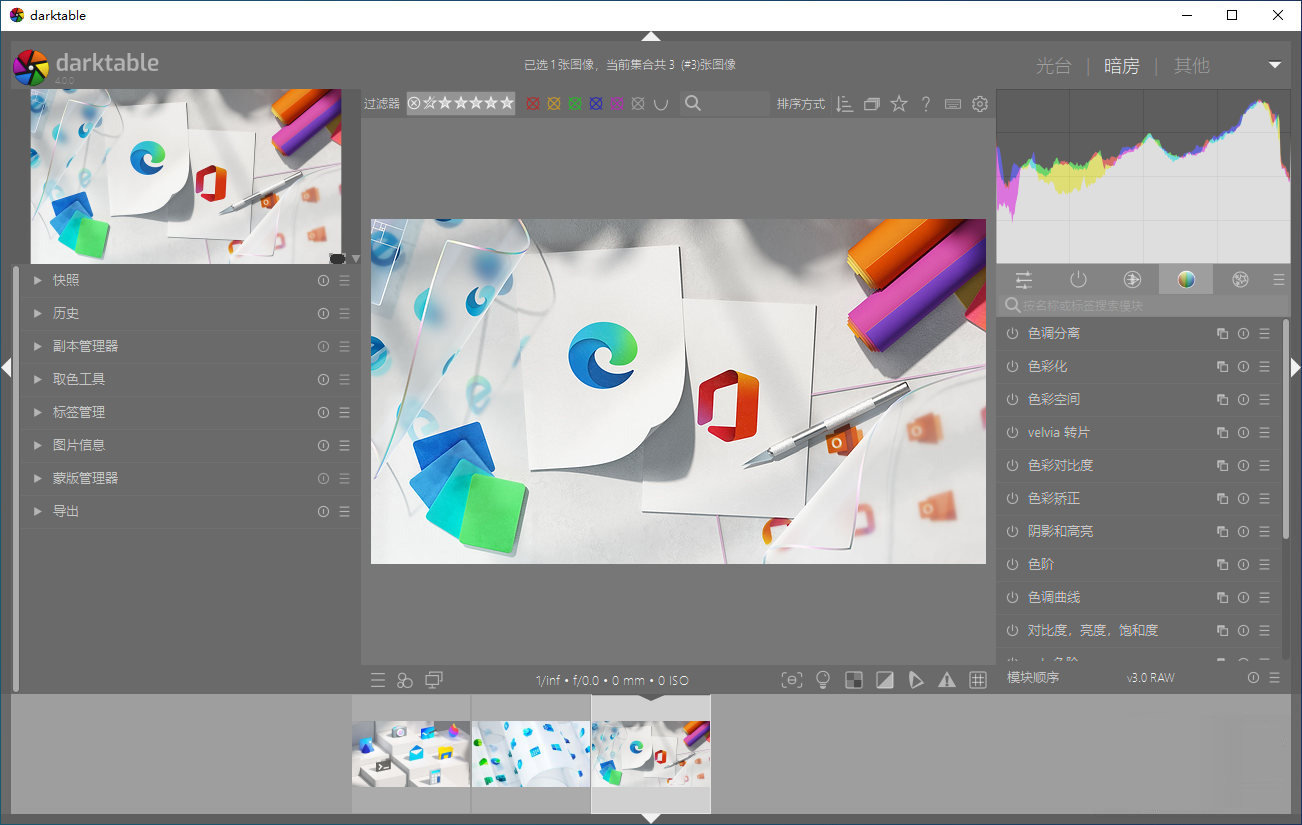
软件特点
- 在整个工作流程中进行无损编辑,您的原始图像永远不会被修改。
- 利用 raw 的真正力量:所有暗表核心功能都在 4×32 位浮点像素缓冲区上运行,启用 SSE 指令以提高速度。
- GPU 加速图像处理:由于 OpenCL 支持(运行时检测和启用),许多图像操作都快如闪电。
- 专业色彩管理:darktable 是完全色彩管理的,支持大多数系统上的自动显示配置文件检测,包括对 sRGB、Adobe RGB、XYZ 和线性 RGB 色彩空间的内置 ICC 配置文件支持。
- 跨平台:darktable 在 Linux、Mac OS X / macports、BSD、Windows 和 Solaris 11 / GNOME 上运行。
- 过滤和排序:按标签、图像评级(星)、颜色标签等搜索您的图像集合,对图像的所有元数据使用灵活的数据库查询。
- 图像格式:darktable 可以导入各种标准、原始和高动态范围的图像格式(例如 JPEG、CR2、NEF、HDR、PFM、RAF ……)。
- 零延迟、可缩放的用户界面:通过多级软件缓存,darktable 提供流畅的体验。
- 联机拍摄:支持某些相机品牌的带有实时取景的相机仪表。
- 支持的语言:darktable 目前提供 21 种翻译:阿尔巴尼亚语、加泰罗尼亚语、捷克语、丹麦语、荷兰语、法语、德语、希腊语、希伯来语、匈牙利语、意大利语、日语、波兰语、葡萄牙语(巴西和葡萄牙语)、俄语、斯洛伐克语、斯洛文尼亚语、西班牙语、瑞典语、乌克兰语、简体中文。
- 强大的导出系统支持 Piwigo 网络相册、磁盘存储、1:1 复制、电子邮件附件,并可生成简单的基于 html 的网络画廊。 darktable 允许您导出到低动态范围(JPEG、PNG、TIFF)、16 位(PPM、TIFF)或线性高动态范围(PFM、EXR)图像。
- 永远不要丢失您的图像开发设置 darktable 同时使用 XMP sidecar 文件及其快速数据库来保存元数据和处理设置。所有 Exif 数据都是使用 libexiv2 读写的。
- 自动化重复性任务:darktable 的许多方面都可以在 Lua 中编写脚本。
- Darktable 分为 5 个模块:Lighttable、Darkroom、Map、Slideshow 和 Tethering。这样做是为了方便地对功能进行分组。
- 一般来说,Darktable 和 Adobe Lightroom 的界面几乎相同,因此切换到 Darktable 时应该没有问题。
darktable 是由摄影师为摄影师创建的。
将同时也是狂热摄影师的开发人员作为目标受众的一部分,有助于了解现实世界的问题、挑战和工作流程。
darktable 是一个摄影工作流程应用程序和原始开发人员。供摄影师使用的虚拟灯台和暗室。它在数据库中管理您的数字底片,让您通过可缩放的灯台查看它们,并使您能够开发原始图像并增强它们。
darktable 在整个流程中以非破坏性方式编辑您的图像。您的原始图像永远不会被修改。专业的色彩管理功能可确保打印过程的保真度,GPU 加速处理意味着您可以使用显卡加快工作流程。
目前darktable包含61个图像操作模块。许多模块支持强大的混合运算符,提供混合功能,适用于输入图像信息和当前模块的输出,或与绘制的蒙版一起使用。
更新日志
The Big Ones
The following is a summary of the main features added to darktable
5.6. Please see the user manual for more details of the individual
changes (where available).
Added optional AI subsystem (build with -DUSE_AI=ON). AI features
are disabled by default in preferences and can be enabled at runtime
without restarting. When disabled, no ONNX Runtime libraries are
loaded and no AI-related activity occurs. Models are downloaded from
a configurable repository and managed through the AI preferences tab.
Added install scripts for Linux and Windows that set up GPU
acceleration for the new AI features. The scripts detect the user's
GPU vendor (NVIDIA, AMD or Intel) and install the matching GPU
runtime. They can be run from a local checkout or fetched and run
online with a single command – see the GPU acceleration
page
in the user manual for details. macOS users and most Windows users
do not need to run anything; GPU acceleration is already bundled.
Added AI object mask tool in the darkroom mask manager. Uses SAM2.1
or SegNext model for interactive object segmentation – click on an
object to generate a precise mask. Supports both foreground and
background prompt points with iterative refinement. The encoder runs
once per image (GPU-accelerated via the AI backend when available),
and the lightweight decoder produces masks interactively. Each click
runs iterative refinement passes that tighten the mask, plus an
optional DenseCRF refinement pass for clean, edge-aware boundaries.
The generated mask can optionally be exported as a PNG for use
with the external raster masks module when finer edge detail is
needed than the vectorized mask provides.
Added neural restore module in the lighttable/darkroom sidebar
covering three AI-based tasks: raw denoise, denoise, and
upscale. Default models: NIND UNet (denoise), RawNIND UtNet2 (raw
denoise), and RealPLKSR 2x/4x (super-resolution), all running on the
ONNX backend. Additional models such as NAFNet (denoise) and BSRGAN
(upscale) are available from the model repository and can be
installed manually. Features include an interactive before/after
split preview with area picker, a strength slider (DWT-based texture
recovery for RGB denoise; linear source/denoised blend for raw
denoise), batch processing with tiled inference, and automatic
library re-import with image grouping and tag propagation from the
source image. Raw denoise writes a DNG (CFA Bayer or LinearRaw);
image denoise and upscale write a TIFF embedding the output ICC profile.
GPU acceleration is inherited from the AI backend. If GPU inference
fails (out of memory, unsupported operator, execution provider crash),
darktable automatically retries on CPU.
Added colorharmonizer module that applies color harmony
corrections in UCS color space, rotating hues toward a target
harmony structure (complementary, split-complementary, triadic,
tetradic, etc.). The saturation of target hues can be controlled,
and custom-defined harmonies with an arbitrary number of anchor
nodes at any angle are also supported. Options are provided to
control the intensity of the effect, protect neutral colors, and
apply a Gaussian filter to smooth harsh transitions. The module can
be synced with the vectorscope in RYB mode, with harmony and
rotation angles controllable directly from the vectorscope. Both CPU
and OpenCL (GPU) implementations are provided.
Added support for HEIF export. User can choose lossless or lossy
compression, all practically supported color depths (8/10/12 bit),
all supported color subsampling options.
UI/UX Improvements
In the crop module, the crop aspect ratio is added to the dimensions
in the crop area preview.
Added the ability to pin any image from the filmstrip in the second
darkroom window. Images can be pinned directly from the 2nd window,
via drag&drop from the filmstrip and via keyboard shortcuts. Two
new actions are the added:
Toggle pinned state for currently developed image
Pin current image in second view
Allow switching between point/area color picker directly on canvas
with a simple Ctrl+Click.
When moving pictures from a collection we switch to the target
collection only if we did not change manually to another collection
during the move and the current collection is now empty.
When copying pictures from a collection we switch to the target
collection only if we did not change manually to another collection
during the copy.
In Color Calibration module the calibration box is now initialized
on the current bounding box. That is, if a zoom is effective the
calibration box will be fully visible and won't require to zoom out.
Make the slider background darker to gain some contrast making them
easier to differentiate from the other labels.
Introduce a condensed mode for the panel's controls widgets. This
mode is off by default and can be select in miscellaneous interface
preference.
Added a 2-up scope showing both the waveform and vectorscope. This
allows for a simultaneous understanding of both the lightness and
chromaticity of an image.
Support rendering and caching higher resolution (6K or 8K) thumbnail
or full-screen preview images in lighttable view. Previously, for
displays larger than a 4K, darktable would render a full-resolution
preview then downscale it. These higher resolution previews also
allow for less jumpy zooming in of high megapixel files.
Increase the resolution of the darkroom view's preview-resolution
images from 720x450 to 1440x900. This produces better data for
various situations, including in scopes and the color picker.
Use darktable icon in desktop environment when running under Wayland
on a KDE-like system. Previously the window manager would use a
generic icon.
Use server-side decorations (SSD) for windows when the user's window
manager is capable of this, to make window decorations consistent
with other applications. If SSD is not implemented (Gnome/Mutter
under Wayland), use client-side decorations (CSD).
Added a welcome screen to help users understand and set the most
relevant configuration options on the first run.
Added touchpad gestures to darkroom and lighttable culling layouts,
including pinch zooming and two-finger panning.
Smartphone-like simultaneous pinch zooming and two-finger panning
are now possible on Linux and Windows.
Zooming gestures are limited to 100%, additionally pressing CTRL
enables zooming up to 1600%.
Caution: this disables the scroll gesture for zooming on MacOS
on trackpad and magic mouse. To restore the former behaviour
disable touchpad gestures in preferences dialog.
Enabled shortcuts for some existing buttons in duplicate manager,
snapshots, and AgX modules.
Enabled shortcuts to cycle through module groups, modules and
module instances.
Added a configuration option to toggle the filmstrip auto-center
behavior. Enabled shortcuts to toggle filmstrip auto-centering and
to explicitly recenter the filmstrip on the current image.
The radius calculated for capture sharpening is now using only the
cen...